Appointed From Outside
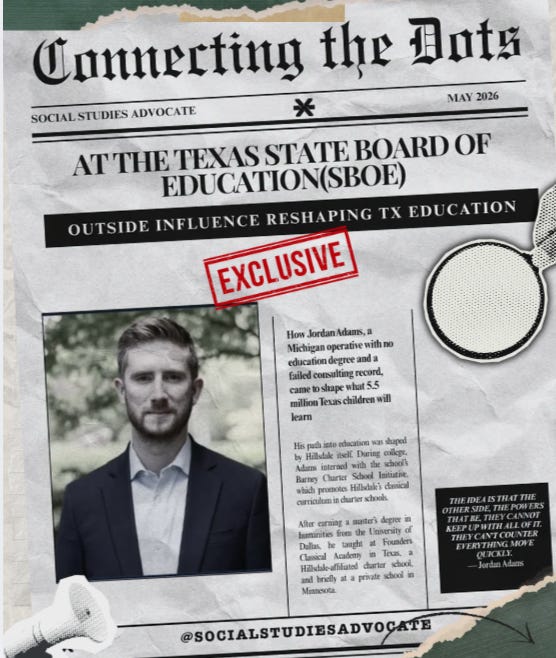
How Jordan Adams, a Michigan operative with no education degree and a failed consulting record, came to shape what 5.5 million Texas children will learn

Jordan Adams’ Road to Content Advisor for Texas Social Studies TEKS
Jordan Adams was appointed as a content advisor to the Texas State Board of Education by SBOE Chair Aaron Kinsey and board member LJ Francis in 2025. The board that made that appointment was shaped by an unusually large influx of outside money into SBOE races during the 2022 election cycle. Charter school interests and aligned PACs spent more than $1 million on board races that year, a level the Association of Texas Professional Educators’ lobbyist described as “unprecedented, unheard of.” Kinsey and Francis were both backed by the Freedom Foundation of Texas PAC.
In addition to Jordan Adams, David Randall, David Barton, and Don Frazier have been appointed as content advisors in a process that has been making statewide and national headlines for the self-evident political bias at play. Today, we are doing a deep dive into Adams and the organizations and politics that influence his perspectives.
The Social Studies TEKS were under revision in 2022, but in August 2022, the state board voted 7-2 to delay adopting the curriculum revision that teacher work groups had spent months producing. Conservative legislators and advocacy groups had objected to the draft, arguing it downplayed American and Texas exceptionalism, incorporated what they called critical race theory, and included content on the LGBTQ Pride movement. The Texas Freedom Caucus threatened legislative intervention if the board did not make substantial changes. Rather than revise or reject specific provisions, the board delayed the entire update.
Kinsey is a member of the Liberty Leadership Council of the Texas Public Policy Foundation, a conservative think tank whose funders include Koch family foundations, the Scaife Foundation, and the Bradley Foundation. That affiliation connects directly to the content advisor panel: Jordan’s fellow advisor Donald Frazier’s Texas Center at Schreiner University received a $70,000 grant from TPPF specifically for “development of Texas Essential Knowledge and Skills Standards” before Frazier was appointed to advise on those same standards. The grant is documented in TPPF’s own IRS Form 990. When Democratic board members raised questions about it at the April 2026 meeting, Kinsey ended the discussion, saying “I don’t know anything about any private contracts,” and voted to advance the standards proposal.
The Frazier grant was not the only financial relationship board members that was made through quiet, backroom deals. Campaign finance records reveal a second financial relationship between Members Kinsey and Francis. On May 28, 2025, the Aaron Kinsey Campaign loaned $90,000 to LJ Francis’s campaign at zero percent interest, with a repayment date of November 13, 2026, approximately three months before Adams was appointed. A second loan of $10,000 was made by Kinsey personally to SBOE District 8 member Audrey Young’s campaign on June 23, 2025. Four days later, Young voted alongside Francis to block renewal of the American Indian/Native Studies course.
No Texas news outlet had previously reported either loan. No Texas teacher organization, school district, or parent group had requested Adams or identified him as a resource.
Who is Jordan Adams?
Jordan Adams grew up in Highland, Michigan and attended Hillsdale College, the small conservative institution in southern Michigan whose stated mission is to preserve “our Western philosophical and theological inheritance tracing to Athens and Jerusalem.” He graduated in 2013 with a degree in political science. He has no degree in education and completed no teacher certification program.
His path into education work was shaped by Hillsdale itself. During his college summers, Adams interned with the college’s Barney Charter School Initiative, an effort to spread Hillsdale’s classical curriculum into publicly funded charter schools. After a master’s degree in humanities from the University of Dallas, he taught at Founders Classical Academy in Lewisville, Texas, a Hillsdale-affiliated charter school, not a traditional public school, and briefly at a private school in Minnesota. He later returned to Hillsdale as a full-time employee of its K-12 Education Office, training teachers across the college’s charter network. His direct supervisor was Dr. Kathleen O’Toole, the daughter of Hillsdale’s president, Larry Arnn. His only Texas classroom experience was inside an institution operating under Hillsdale’s ideological model.
In September 2020, Adams appeared at a White House event marking the creation of President Trump’s 1776 Commission, a federal body established to promote what the administration called “patriotic education” in response to the New York Times Magazine’s 1619 Project. He was one of a small group of panelists selected by Arnn. His remarks, published by Hillsdale on its own K-12 blog, make his views on American history education explicit. He criticized approaches that emphasize structural inequality as using “simplistic explanations like ‘class struggle’ and ‘systemic racism’” as tools to “tear down their country,” and warned that the United States is “never more than a single generation of corrupted education away from extinction.” These were not academic observations. They were a political argument, delivered to senior federal officials, about whose version of American history belongs in schools. And now, he is shaping social studies education for Texas students.
The Business Model
In 2023, Adams described why he had formed his consulting company to attendees at the Moms for Liberty National Conference in Philadelphia, a gathering of school board members, candidates, and political operatives focused on K-12 policy. Audio of his remarks was recorded and later published by the Bucks County Beacon. He told the conference that conservative school board majorities needed someone “on our side” who could be contracted to do the kind of curriculum and policy work that, in his framing, progressive organizations (professional education organizations) had been doing for years. He was not describing a business built around educational expertise or student outcomes. He was describing a political service operation.
He was equally direct about his tactics. He advised conservative boards to move quickly and pursue changes on multiple fronts simultaneously, reasoning that organized opposition cannot effectively counter more than one issue at a time: “The idea is that the other side, the powers that be, they cannot keep up with all of it. They can’t counter everything. Everything should be up for debate. We should be moving on multiple policy areas and it should be happening quickly and efficiently.” He characterized his own position inside school systems as “the fox in the henhouse”--a consultant who knows how to advance an external agenda within institutions whose professional staff did not share the goals of the boards that hired him. When he sits across from a school superintendent, he told the audience, “we both know the game that’s being played right now.”
Two other statements from that conference are relevant given his subsequent appointment in Texas. He told the audience: “Don’t call me an expert, please. I’m so sick of the word expert, I could scream.” He also said that state academic standards are “not hard to meet” and are “pretty laughable in most states.” The Texas State Board of Education’s website lists him as an “Independent Education Consultant” appointed alongside credentialed academics, including a professor of philosophy from the University of Texas at Austin and a historian at Schreiner University. He is now writing the state standards, something he characterizes as “laughable.”
A Consulting Record Built on Bypassed Oversight
Before his Texas appointment, Adams had pursued consulting contracts in three other states. Each engagement followed a consistent pattern: a sympathetic board member arranged his entry, often without going through normal administrative approval channels, and the resulting work was rejected or terminated amid community opposition. In Sarasota, Florida, a $28,000 contract he pitched through Moms for Liberty co-founder Bridget Ziegler was rejected by one vote after approximately 70 community members appeared to oppose it. His pitch document described his role as implementing policies “over the objections of staff members,” meaning he would work within a district to advance the board’s agenda even when the district’s own teachers, curriculum directors, and administrators opposed the changes. That is what he was selling.
In Pennridge, Pennsylvania, a school board hired him at $125 per hour with no spending cap and no defined deliverables. The district’s own curriculum experts had proposed age-appropriate content for first and second graders: “Rules and Responsibilities,” “Geography,” and “Important People and Places.” Adams instead proposed that 6- and 7-year-olds study “American History: 1492–1787” and “World History: Ancient Near East.” He spent less than 90 seconds in his presentation covering that proposal to restructure all five elementary grade levels, without explaining how teachers were supposed to teach nearly 300 years of American history to students still learning to read. That sequence, Western civilization chronology imposed on early elementary grades, is the same organizing logic his Texas submission applies to grades 3 through 7, where Ancient Mesopotamia, Ancient Israel, Greece, and Rome appear before age nine. Pennridge got a preview of what Texas has now been offered. After $7,500 in billings, a board member reviewed his work and called it “amateurish,” “horrible,” and reflective of “a total lack of preparation.” The final product was characterized as “an embarrassment.” The contract ended when Democrats won board seats in November 2023. In Francis Howell, Missouri in early 2025, a board member hired Adams, by then rebranded as J.C. Adams Consulting, without board authorization, without administration approval, and without competitive procurement. The board member had connected with him through the School Board Academy for Excellence, a national network that trains conservative board candidates and circulates aligned consultants. The district’s superintendent wrote that the contract “should never have been executed.” The district paid his $3,000 invoice anyway.
The common element across every engagement is not simply that the contracts were contentious. It is that Adams’s entry point was consistently a board member willing to bypass the oversight structures that public institutions use to evaluate outside contractors, exactly the approach he had described and recommended to his Moms for Liberty audience.
What He Submitted
Adams’s February 2026 SBOE submission is a content bank of suggested material for grades 3 through 7, covering world and American history from prehistory through approximately 2016. It runs to more than 30 pages and is a public document. Its organizing framework appears in a repeated section header running through every grade level and every historical period: “Connections to America and Texas.” Ancient Mesopotamia, the Middle Ages, the Protestant Reformation, the Renaissance--every topic is filtered through the same question: how did this lead to us? That framing is a legitimate pedagogical thread, but in Adams’s submission it becomes the dominant and at times sole lens. Historical events and peoples are evaluated primarily for what they contributed to the American founding narrative, rather than on their own terms or in their own contexts.
The submission’s treatment of religion is systematic. Ancient Israel receives a dedicated section as one of four foundational civilizations in the third-grade unit, with sustained positive attention: Abraham is described as “the Father of Israel,” Moses is credited with leading the Israelites out of slavery, and the Ten Commandments are connected to American law. Appropriate to Sunday school perhaps, but not to a public school social studies classroom. Christianity is traced positively across every grade level, from Rome’s legalization of the faith through the Puritan founding narrative through the framing of Martin Luther King Jr.’s “I Have a Dream” speech as an appeal to the Declaration of Independence. Islam’s introduction to fourth-grade students reads: “Spread of Islam through wars of conquest called jihad across Arabia, the Holy Land, Asia, Africa, and Spain.” The submission includes no treatment of Islamic theology or spiritual tradition, and no mention of the Islamic Golden Age’s contributions to mathematics, medicine, astronomy, or philosophy--knowledge that does appear later in the document, framed as material that arrived in Europe through the Crusades. Islam enters the curriculum as a military force and exits the same way, with sections on “Christian defense against the conquests of Ottoman Muslims” at Malta, Lepanto, and Vienna. Such unbalanced coverage and framing represents ideological indoctrination, not education.
The submission’s treatment of race and reform follows a similar logic. The phrase “systemic racism” does not appear, consistent with Adams’s stated view that it is a “simplistic explanation” used to undermine the country. The Progressive Era is introduced in seventh grade under the heading “Reasons why the Progressives disagreed with the Founders,” framing a generation of reform as ideological deviation rather than historical response to documented industrial harms. Lyndon Johnson’s Great Society is described as programs that “gave the federal government more power and expanded welfare.” The State of Israel’s founding in 1948 receives a dedicated bullet point, ignoring the violence of its founding, awkwardly framing it in terms of later peace treaties. The Palestinian Nakba is not acknowledged.
On Texas-specific content, Adams defers explicitly to fellow advisor Donald Frazier no fewer than eight times, for the Texas Revolution, Texas settlements, the Civil War in Texas, major battles involving Texan soldiers, Reconstruction successes, and the contributions of African American legislators during Reconstruction. That division is not incidental given that Frazier’s institute received the TPPF grant for TEKS development before either man was appointed. Adams provides the Western civilization framework from Michigan; Frazier fills in the Texas content. The curriculum has been effectively divided between two advisors whose institutional connections run to the same funding networks that shaped the board that appointed them.
Historians who have reviewed the Hillsdale curriculum that Adams’s submission reflects have been direct. Sean Wilentz, a Princeton historian who has also criticized the 1619 Project, and thus cannot be dismissed as a partisan critic, has said the curriculum “fundamentally distorts modern American history into a crusade of righteous conservative patriots against heretical big-government liberals” and “has no place in any school system that values education over indoctrination.” A member of Adams’s own content advisor panel, Kate Rogers, wrote in her March 2026 feedback that the draft was “blurring the separation between Church and State intended by the country’s founders and violating the First Amendment.” Her assessment came from inside the process, reviewing a draft that Adams’s submission had helped to shape.
When Adams submitted his response to the Work Group B draft in March 2026, it ran to a single page. He endorsed the consensus document almost entirely. His one substantive dissent was that the standards were “wanting in memorable dates, famous phrases and quotes, and historical songs and adages that students may learn by heart and carry with them as citizens.” That is a specific pedagogical vision: civic recitation over historical inquiry. The brevity of the feedback also reflects something about where things stood by March; his February content bank had already been absorbed into the draft he was reviewing.
What Follows
The standards Adams is helping to shape will take effect in the 2030–31 school year and will govern what every Texas public school teacher is required to teach from kindergarten through twelfth grade. More than 5.5 million students are currently enrolled in Texas public schools. Thirteen percent of them are Black. The state has significant and growing Asian, Hindu, Sikh, and Muslim student populations. Native Americans have been part of Texas throughout, and continue to be. The histories of those communities, along with those of more than 150 countries absent from Adams’s proposed K–8 content bank, are marginal or absent from the framework he submitted, and the current TEKS proposal. The major professional associations for social studies, history, and geography education have each raised concerns about the Work Group draft: factual errors, elimination of the standalone World Cultures course, and content that subordinates global history to an American exceptionalism narrative. A teacher who participated in the work group reported that an early draft had removed the New Deal, Japanese internment, and the use of atomic weapons, all currently required by the existing TEKS. Geographic and other social studies skills that support critical thinking are largely absent. Furthermore, there has been no documented work to align with the Texas College and Career Readiness Standards as mandated by Texas Education Code. How prepared students with the limited view of the world offered by the current proposal will fare in college in career is an important question that we all need to be asking.
Adams holds no education degree. His only Texas classroom experience was at a Hillsdale-affiliated charter school. His consulting record elsewhere was characterized by bypassed administrative oversight, community opposition, and contracts that ended in rejection or termination. He described his approach, to a national audience of school board activists, as being “the fox in the henhouse.” He said state standards are “laughable.” He asked not to be called an expert. He was appointed anyway, by two board members who had not disclosed to the public that one had loaned the other $90,000 three months before the appointment was made. Texas students deserve better. Contact your State Board member today and demand accountability.
I appreciate your coverage and exposure on the indoctrination tactics used by the TX Republican Party. This is well-written. I would love it if you could cite sources? The current party is far from conservative in the sense that its goals are to dismantle our U.S. constitutional rights and public education system, not conserve them. I’d like to suggest abandoning the word conservative to describe the Republican machinery. I’d prefer to reclaim that word and reserve it to refer to preservingour founding documents and our natural environment. Fundamentalist might be a better choice to describe Republicans instead.